
Playground surfacing in Dallas–Fort Worth
Poured rubber, rubber tiles, engineered wood fiber, rubber mulch and synthetic turf, chosen for your fall height, your budget and how much upkeep your staff can handle.
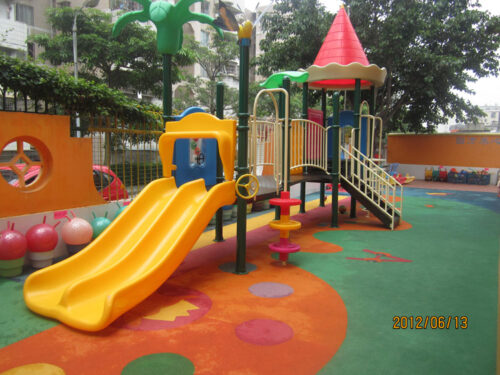
The five surfacing options compared
Every option has to cushion a fall from the equipment’s highest play point. After that, the choice is about wheelchair access, upkeep, cost and heat.
| Surfacing | Wheelchair access | Upkeep | Upfront cost | In Texas sun |
|---|---|---|---|---|
| Poured-in-place rubber | Yes | Low; patch wear spots | $$$$ | Gets hot, especially dark colors |
| Rubber tiles | Yes | Low; check seams | $$$ | Gets hot |
| Synthetic turf over a pad | Yes | Low; brush and refill | $$$ | Gets very hot |
| Engineered wood fiber | Only when kept firm and level | High; rake and top up | $ | Stays coolest |
| Rubber mulch | Not usually | Medium; rake and top up | $$ | Gets hot |
Wheelchair access means the surface passes ASTM F1951. Every option must also pass ASTM F1292 for the fall height of your equipment.
Loose fill settles. Install 12 inches to keep 9.
Wood fiber and rubber mulch compress and get kicked out from under swings and slides. The CPSC handbook notes that 12 inches of loose fill compresses to about 9 inches over time, so plan the border and the first delivery for the full 12.
Mark the 9-inch level on a post so staff can see when to top up, and rake the high-traffic spots back into place every week.
Never spread loose fill over concrete or asphalt. It needs a soft, well-drained base underneath.
Top up when the fill reaches the 9-inch mark.
Surfacing on DFW sites
North Texas clay holds water, and summer sun is hard on rubber. Two things to plan for:
- Drainage firstPoured rubber and tiles sit on a compacted stone base that lets water out. Without it, clay soil stays wet and the surface can heave or crack.
- Heat secondShade over the play area and lighter colors keep rubber and turf cooler. Wood fiber stays coolest but needs the most care.


Questions about playground surfacing
Which surfacing is ADA accessible?
Poured-in-place rubber, rubber tiles and turf over a pad usually pass ASTM F1951, the accessibility test. Engineered wood fiber can pass when it is kept firm and level. Rubber mulch usually does not.
How thick does the surfacing need to be?
Thick enough to pass ASTM F1292 for the fall height of your tallest equipment. For loose fill, the CPSC suggests installing 12 inches, which settles to about 9. For rubber, the manufacturer sets the thickness for each fall height.
Can new equipment go on our old surfacing?
Sometimes. Check that the old surfacing is rated for the new equipment’s fall height and covers its full use zone, at least 6 feet around most equipment.
How long does poured rubber last?
It depends on sun, traffic and upkeep. Shade and patching worn spots under swings and slide exits help it last longer. Ask us for the warranty terms on the product you choose.
Need surfacing for a new or existing playground?
Send the size of the area, photos and the height of your tallest equipment. We reply with options and pricing.